Reverse Line Movement in Basketball Betting — Following Sharp Money
 Available in US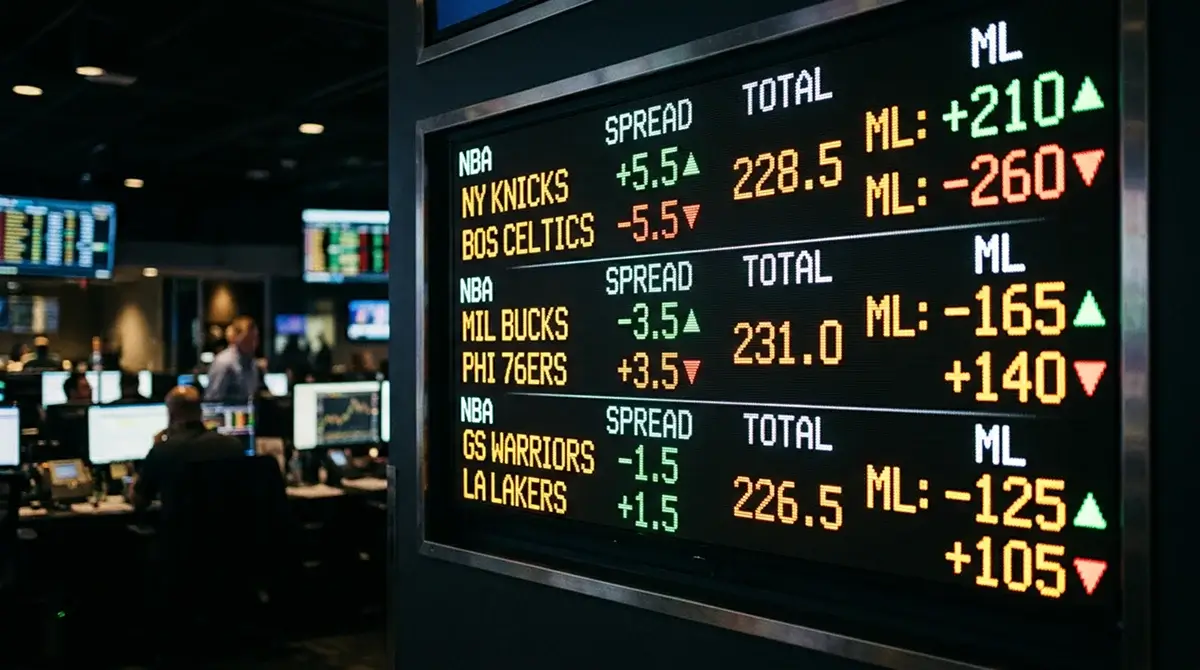
I remember staring at an NBA spread that made no sense. Seventy percent of public bets sat on the home favourite, yet the line moved from -5 to -4. Money was pouring in on one side, and the line moved the other way. My first instinct was that the sportsbook had made an error. It had not. That was reverse line movement in action — and once I understood what it signalled, I never looked at a basketball betting line the same way again.
Reverse line movement occurs when the betting line moves against the side receiving the majority of public wagers. It is one of the clearest indicators that sharp bettors — professionals who move markets with large, informed wagers — have taken a position opposite to the public. In a market where 70-75% of global wagering volume flows through in-play channels, the pre-game line movement tells a concentrated story about where the smart money sits before the ball goes up.
What Reverse Line Movement Means in Basketball Markets
The mechanics are straightforward once you strip away the jargon. Sportsbooks set lines to balance their exposure — ideally, they want roughly equal money on both sides of a bet, earning their margin regardless of the result. When the public heavily backs one side, the natural adjustment is to move the line toward that side to attract money on the other. If 70% of bets land on the favourite at -5, the line should move to -5.5 or -6 to incentivise underdog action.
When the opposite happens — the line moves toward the public side, or stays flat despite heavy one-sided action — it means the sportsbook is responding to something other than ticket count. That something is dollar-weighted action from sharp accounts. A single $50,000 bet from a respected sharp account carries more weight in the sportsbook’s risk management than five hundred $20 bets from recreational accounts. The sportsbook moves the line to manage its exposure to the sharp money, even if it increases exposure to the public money.
For basketball, RLM is particularly informative because the NBA attracts a disproportionate share of professional betting activity. The sport’s high frequency of games, deep statistical database, and relative predictability compared to sports like football make it a natural habitat for quantitative bettors. When those bettors collectively take one side of a basketball line, the sportsbook listens.
Not every RLM signal is actionable. Sometimes a line moves against the public because of late injury news that has not yet been widely reported. Sometimes it reflects a sportsbook copying a line move from a respected originator rather than responding to its own action. Context matters. RLM is a signal to investigate further, not a trigger to bet blindly.
Steam Moves — When Multiple Sportsbooks Shift at Once
During the 2024 NBA season, I watched an opening line at one sportsbook move two full points in under ninety seconds — from -3 to -5 with no public news to explain it. Within five minutes, every major operator had matched the move. That was a steam move, and it is the most aggressive form of sharp action in basketball betting.
A steam move occurs when a coordinated burst of sharp money hits a line simultaneously at multiple sportsbooks, forcing a rapid, industry-wide adjustment. The origin is usually a syndicate — a group of professional bettors operating through multiple accounts — or a single sharp bettor placing large wagers at several operators within a narrow time window. The Americans wagered $166.94 billion on sports legally in 2025 — a market that size attracts sophisticated operators capable of moving lines across the entire industry in minutes.
Steam moves differ from regular RLM in speed and magnitude. Regular RLM might shift a line half a point over several hours. A steam move can shift it one to three points in minutes. The practical implication for UK bettors is timing: if you can identify a steam move early — before your preferred sportsbook adjusts — you can grab the pre-move price and ride the sharp side. If you are late, you are buying the inflated line and the value has already been extracted.
Identifying steam moves in real time requires monitoring odds feeds across multiple sportsbooks simultaneously. Several third-party tools track line movements and flag sudden synchronised shifts, though the best of these carry subscription fees. The free alternatives offer delayed data, which reduces their usefulness for catching steam but still provides valuable post-hoc analysis of where sharp money is landing. Check out our guide on UK Gambling Statistics for Basketball — Market Size, Demographics, and Trends as well.
Line Movement Tools Available to UK Bettors
You cannot follow sharp money if you cannot see the lines moving. The good news is that line movement tracking has become far more accessible than it was even three years ago.
Odds comparison websites are the starting point. They aggregate real-time odds from multiple UK sportsbooks and display them side by side, often with historical charts showing how lines have moved since opening. These tools are free and adequate for identifying large line movements, though they typically do not distinguish between public and sharp money flows.
Dedicated line movement platforms offer more granularity. The best ones show betting percentages (what percentage of bets and dollars are on each side), line histories with timestamps, and alerts for reverse line movement and steam moves. Some also provide consensus lines — the average across all tracked sportsbooks — which helps identify which operators are leading movements and which are following.
The limitation from a UK perspective is that most line movement data originates from the US market. UK sportsbooks often shadow US lines with a slight delay, which means the RLM signal you see might already be priced into the UK market by the time you act. The workaround is to monitor US-facing odds comparison tools for early signals and then check whether your UK sportsbook has adjusted. When it has not yet, you have a brief window to capture value that closing line value analysis will confirm later. Discover everything about basketball betting guide here.
How can I see reverse line movement for NBA games?
Odds comparison websites show line movements across multiple UK sportsbooks in real time. Dedicated line movement platforms provide additional detail including betting percentages, dollar-weighted action, and alerts for reverse line movement. Most of this data originates from US markets, so monitoring US odds feeds gives you earlier signals than waiting for UK sportsbook adjustments.
What is a steam move in basketball betting?
A steam move is a rapid, coordinated burst of sharp money that hits a line at multiple sportsbooks simultaneously, forcing an industry-wide adjustment within minutes. Steam moves typically shift lines by one to three points and are driven by professional bettors or syndicates. They differ from regular reverse line movement in both speed and magnitude.
Written by the editors at Basketball Betting Guide.