Live Basketball Betting in the UK — In-Play Strategy, Timing, and Market Mechanics
 Available in US
Third quarter, Tuesday night, Celtics versus Cavaliers. Cleveland is down nine points, and the live moneyline has them at 4.20. Then Donovan Mitchell hits three consecutive threes in ninety seconds. The deficit evaporates. By the next timeout, the moneyline has swung to 2.10 and the total has jumped six points. If you were watching, you saw it coming — the momentum shift was visible before the sportsbook’s algorithm caught up. That window, the gap between what is happening on the court and what the odds reflect, is the entire premise of live basketball betting.
Live betting — in-play wagering on markets that update in real time during a game — now generates 62.35 percent of online sports betting revenue globally and is growing at a compound annual rate of 13.62 percent. In basketball specifically, the sport’s structure makes it uniquely suited to live wagering. High scoring means the lead changes frequently. Four quarters create natural breaks for reassessment. Timeouts, free throws, and substitution patterns all produce micro-pauses where odds recalibrate and new markets open. The result is a betting environment that is faster, more reactive, and more information-dense than anything available pre-game.
This guide is specifically about how live betting works in the context of UK basketball markets — how odds move, when the windows of opportunity appear, what the risks are, and how to make decisions under time pressure without losing discipline.
Table of Contents
- How Live Basketball Odds Move During a Game
- Reading Momentum Shifts and Timing Your Bets
- Quarter and Half Markets in Live Betting
- Cash Out During Live Games — Quick Decisions Under Pressure
- Mobile Live Betting — Speed, Latency, and App Features
- The Risks of Live Betting and How to Set Limits
- Live Basketball Betting — Common Questions
How Live Basketball Odds Move During a Game
Pre-game odds are set by humans — trading teams who assess matchups, incorporate market signals, and set opening lines. Live odds are driven primarily by algorithms. The sportsbook’s in-play engine ingests the score, the time remaining, possession data, and a statistical model of expected outcomes, then recalculates probabilities multiple times per minute. The human traders still intervene on major events — a star player fouling out, a key injury — but the baseline pricing is algorithmic.
This distinction matters because algorithms price efficiently within their model but can lag when something outside the model changes. A coach switching to a zone defence in the second quarter is not a data point the algorithm processes directly — it shows up indirectly through scoring changes, but there is a delay. A player returning from the bench earlier than expected after picking up two early fouls is another example. If you are watching the game and the algorithm is reading the box score, you have a temporary information advantage.
The share of in-play bets globally has reached 70 to 75 percent of total betting turnover, and in the US market specifically, in-play wagering climbed to around 50 percent of handle by the end of 2025, up from 35 to 40 percent the year before. That growth means more liquidity in live markets, which is good for UK bettors — more money flowing through means tighter spreads and more consistent availability. But it also means the algorithms are getting smarter. The easy windows that existed three years ago, where you could reliably exploit a slow line update after a scoring run, have narrowed. The edges in live betting today are subtler and require faster recognition.
One pattern I have tracked consistently: odds overreact to scoring runs in the first half and underreact to them in the fourth quarter. A 10-0 run in the first quarter shifts the live line dramatically, even though first-quarter runs are poor predictors of final outcomes. The same 10-0 run with four minutes left in the fourth quarter moves the line less aggressively per point because the remaining game time is shorter, but the impact on the actual result is much higher. This asymmetry creates two opportunities — fading early runs that the market overvalues, and acting quickly on late runs that the market has not yet fully priced.
Market suspensions are another factor unique to live betting. When something significant happens — a flagrant foul, a potential injury, a video review — the sportsbook suspends all live markets until the situation is resolved. These suspensions can last anywhere from thirty seconds to several minutes. The moment markets reopen, the odds reflect the new information, and any edge from anticipating the outcome of the review is gone. What you can do, however, is prepare your position during the suspension. If a star player appears injured and you believe the backup is a substantial downgrade, have your bet slip loaded and ready to execute the instant markets reopen. The first few seconds after a suspension lifts are among the most inefficiently priced moments in live betting.
Reading Momentum Shifts and Timing Your Bets
Momentum in basketball is not mystical — it is measurable. When a team goes on a scoring run, the underlying cause is usually identifiable: a defensive adjustment forces turnovers, a hot shooter enters the game, a mismatch gets exploited repeatedly. The question for live bettors is whether the momentum is sustainable or temporary. A 12-0 run driven by a bench player hitting four contested threes is unlikely to continue at that rate. A 12-0 run driven by a defensive switch that creates open layups on every possession might keep going until the opponent adjusts.
I use a simple mental framework during live games. First, identify the cause of the run. Second, assess whether the opponent has an obvious counter. Third, estimate how long before the counter is deployed — usually a timeout or a substitution. If the cause is structural and the counter is not obvious, the momentum is real and the live odds probably have not caught up yet. If the cause is shot variance — a player making shots they normally miss — the regression is coming, and the current odds may actually overvalue the team on the run.
Timeouts are the most important inflection points in live basketball betting. A coach calling timeout during a 10-0 opponent run is making an adjustment. The live odds typically hold steady through a timeout, but the game dynamics are about to change. I have found that the two minutes immediately after a timeout called by the trailing team are among the most profitable windows for backing the team that was behind. The coach has made adjustments, the players are refocused, and the run frequently stalls. The reverse is also true — if the team on a run calls a timeout themselves, they are often conserving energy and resetting, not accelerating.
Foul trouble adds another layer. When a key player picks up their fourth foul in the third quarter and sits, the team’s offensive and defensive profile changes immediately. The live line adjusts, but it adjusts based on aggregate bench performance data. If you know that the specific backup player entering the game shoots 42 percent from three but the team’s bench overall shoots 34 percent, the aggregate adjustment understates the actual quality of the replacement. These small informational gaps are where live betting edges live.
The emotional component is worth acknowledging too. Watching a game in real time creates narrative bias — you feel the momentum, you see the crowd react, and your brain interprets these signals as predictive when they are often just noise. A team that has just made three consecutive turnovers “feels” like they are collapsing, but three turnovers in three possessions is well within normal variance for most teams. The discipline to separate what you see from what the data says is the hardest skill in live betting, and it is the one that separates profitable live bettors from everyone else.
Quarter and Half Markets in Live Betting
Live segment markets — quarter winners, quarter totals, half spreads — open and close in real time during the game, and they behave differently from their pre-game equivalents. A pre-game first-quarter total is priced based on historical data and projected pace. A live first-quarter total with six minutes remaining is priced based on the actual score plus a projected scoring rate for the remaining time. That projection uses the current pace of the game, which means it adapts quickly but can be caught off-guard by late-quarter shifts.
The second quarter is where I have found the most consistent live betting opportunities. Bench rotations typically begin early in the second, and the scoring rate often changes materially when second-unit players replace starters. If a team’s bench unit ranks in the bottom five in scoring efficiency, the second-quarter total may still be priced off the first-quarter pace, which the starters set. That disconnect between bench reality and first-quarter-derived pricing creates a window.
Third-quarter betting is its own animal. Teams come out of the half-time break with adjusted game plans, and the third quarter in the NBA is historically the most volatile in terms of scoring differentials. Some teams — the late-2010s Warriors were the iconic example — routinely blew games open in the third quarter. Others chronically collapse. If you track third-quarter net rating by team, you will find that the variance between the best and worst teams in this quarter is wider than in any other period. That variance, combined with the fact that third-quarter markets reset after the half-time break, makes it a segment worth specialising in.
Cash Out During Live Games — Quick Decisions Under Pressure
Cash out feels like a safety net, and sportsbooks market it that way. Your team is up by twelve in the third quarter, the cash-out offer is sitting at eighty percent of the full payout, and the little voice in your head says “take the guaranteed money.” I have pressed that button more times than I would like to admit, and the honest truth is that most of those decisions were emotional, not mathematical.
The cash-out offer is not a fair-value price. The sportsbook builds a margin into the cash-out calculation, just as it builds a margin into the original odds. If the true probability of your bet winning at that moment is 80 percent, the cash-out offer might reflect 72 or 73 percent of the expected value — the sportsbook takes a cut for offering you the option. Mobile applications handle approximately 78 percent of online bets globally, and the cash-out button sitting right there on your phone screen during a live game is designed to be tapped impulsively.
That said, cash out has legitimate strategic uses. If you placed a pre-game bet and new information during the game materially changes your assessment — a key injury, a tactical shift you did not anticipate — cashing out cuts your exposure to a scenario you no longer believe in. The decision should be based on your updated probability estimate, not on the current score or your emotional state. If the cash-out offer exceeds your revised expected value for the bet, take it. If it does not, hold. Framing it as a new bet at the implied odds of the cash-out helps strip out the emotion: “Would I place this bet right now at these odds?” If yes, do not cash out. If no, take the money.
Partial cash out, available at several UK sportsbooks, adds nuance to this decision. Instead of closing your entire position, you can cash out a percentage — say fifty percent — and let the remainder ride. This is functionally identical to reducing your stake mid-game. If your pre-game analysis was sound but the in-game situation introduces uncertainty you did not expect, taking fifty percent off the table while leaving half exposed is a reasonable middle ground. Auto cash out, which triggers automatically when the offer reaches a threshold you set, is useful if you are watching late-night NBA games and might fall asleep before the result — set the auto cash out at a level you are comfortable with, and let the system manage the exit.
Mobile Live Betting — Speed, Latency, and App Features
Charlie Baker, the NCAA president, made the observation that people in 2018 simply were not thinking about how fast sports betting would end up in the palm of your hand. That applies doubly to live basketball betting. The entire value proposition of in-play wagering depends on speed — speed of information processing, speed of decision-making, speed of bet execution. And for UK bettors placing NBA bets between midnight and 3:00 a.m., that speed runs through a mobile phone.
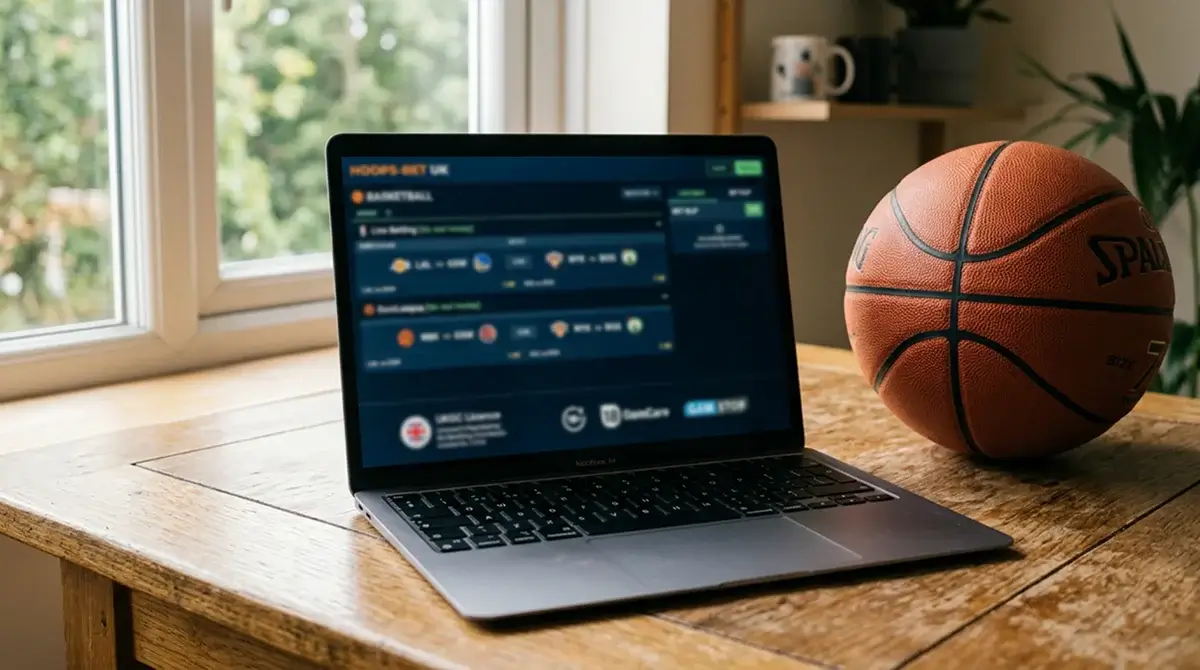
Latency — the delay between tapping “place bet” and the bet being confirmed — is the single most important technical factor in mobile live betting. In a fast-moving basketball game, a half-second delay can mean the difference between getting a live spread at +4.5 and having the bet rejected because the line has already moved to +3.5. Different sportsbook apps handle latency differently. Some confirm instantly at the current price and adjust if the odds have moved. Others hold the bet for a moment and reject if the price changes. Still others offer a “accept better odds” toggle that automatically confirms if the line moves in your favour but rejects if it moves against you. Knowing how your chosen operator handles live bet confirmation before you need it is essential — you do not want to discover the mechanics during a critical moment in the fourth quarter.
Ninety-five percent of UK online gambling happens from home, and 76 percent of bettors aged 18 to 24 use mobile devices. For NBA live betting specifically, the phone is not optional — it is the interface. That means the app’s basketball section needs to be accessible without digging through three levels of navigation, the bet slip needs to load quickly, and the live odds display needs to update in real time without requiring a page refresh. Some operators handle this well. Others still treat basketball as a secondary sport behind football and horse racing, burying the NBA markets and making live betting needlessly cumbersome. Before committing to a sportsbook for NBA live betting, test the app on a busy NBA night with multiple simultaneous games and see how it performs under load. Check out our guide on March Madness Betting From the UK — How to Bet on the NCAA Tournament as well.
The Risks of Live Betting and How to Set Limits
I need to be direct about something: live betting is the most psychologically dangerous form of sports wagering. The speed, the constant availability of new markets, the dopamine hit of a quick win — it is engineered to keep you engaged, and it works. Forty-three percent of Americans now believe legal sports betting is bad for society, up from 34 percent in 2022, and the live betting format is a significant driver of that concern.
The fundamental risk is volume. In pre-game betting, you place your bets and wait. In live betting, you can place a new bet every few seconds for two and a half hours. A bad night can turn into a chase — you lost the first-quarter bet, so you double down on the second quarter to recover, then the half-time spread, then the third quarter. Each bet feels justified in the moment. The cumulative loss is anything but. I have watched experienced bettors — people who are disciplined and profitable in pre-game markets — lose a month’s worth of profit in a single live session because the format overwhelmed their usual controls.
Set limits before the game starts, not during it. Decide in advance how many live bets you will place, what your maximum stake per bet is, and what your total live betting budget for the session is. Write these numbers down. When you hit any of them, close the app. UKGC-licensed sportsbooks are required to offer deposit limits, session time limits, and reality check alerts — use them. GAMSTOP, the national self-exclusion scheme, covers all licensed operators if you need a full break. The same-game parlay guide covers another market where discipline is critical, and the psychological principles apply across both formats.
Live basketball betting is a powerful tool for informed bettors who watch games closely and can process information quickly. It is equally powerful at separating undisciplined bettors from their money. The market does not care which category you fall into — it will treat you accordingly. Discover everything about basketball betting guide here.
Live Basketball Betting — Common Questions
Why do live basketball betting odds change so quickly?
Live basketball odds are driven by algorithms that recalculate probabilities multiple times per minute based on the current score, time remaining, and possession data. Basketball’s high scoring rate means the game state changes rapidly — a single three-pointer can shift the lead and trigger an immediate odds recalculation. The speed of change is highest during scoring runs and lowest during free throws and timeouts.
Is cash out worth using during live NBA games?
Cash out can be worth using when new in-game information materially changes your assessment of the bet — a key injury, an unexpected tactical shift, or a situation you did not anticipate. However, the cash-out offer always includes a margin for the sportsbook, meaning you receive less than the true fair value of your position. The decision framework is simple: would you place this bet right now at the implied odds of the cash-out? If yes, hold. If no, cash out.
What is the best time during a basketball game to place a live bet?
The most consistent opportunities tend to appear at transition points: immediately after timeouts called by the trailing team, during second-quarter bench rotations when scoring pace changes, and in the early third quarter after half-time adjustments. First-half scoring runs that cause large odds swings are also worth fading, as the market tends to overreact to early momentum. Late fourth-quarter bets carry the most risk due to intentional fouling and clock management.
Can I use live betting on EuroLeague games from UK sportsbooks?
Yes. Most major UKGC-licensed sportsbooks offer in-play markets for EuroLeague games, though the depth of coverage is typically less than for the NBA. You can expect live moneyline, spread, and total markets for EuroLeague fixtures, with some operators also offering live quarter markets. The main practical difference is timing — EuroLeague games usually tip off in the early evening UK time, making live betting far more accessible than late-night NBA fixtures.
Prepared by the Basketball Betting Guide editorial staff.